Big News For Little Minds
Nepal Tibet Glacial Collapse Causing Landslides & Flash Floods 2026 Lesson Pack!
Nepal Tibet Glacial Collapse Causing Landslides & Flash Floods 2026 Lesson Pack!
Couldn't load pickup availability
A sensitive Nepal–Tibet flash floods newspaper and activity pack helps young readers understand the science behind a major mountain disaster in a calm, factual way. The main reading explains how scientists believe a glacial collapse sent ice, rock and mud downhill, beginning a dangerous chain of landslides, river blockages and fast-moving flood water, while also exploring rescue efforts and the continuing risk of further flooding.
Included in this news newspaper/article package:
Main Current Events & Disaster Science Article – introduces the disaster in the mountainous Nepal–Tibet border region, the reported deaths and missing people, ongoing rescue efforts and the early reports that an earthquake might have been responsible. It then explains the USGS finding that part of a glacier collapsed high in the mountains, producing vibrations equivalent to a magnitude 5.2 seismic event (pages 1–2).
How the Flash Flood Developed – explains the possible chain involving ice, rock, mud, water and debris. Scientists believe debris may have temporarily blocked a river, allowing water to collect behind a natural dam before the barrier failed and sent a powerful surge downstream. The article states that the destructive flow travelled around 100 kilometres (62 miles) along river systems (page 2).
Continuing Flood Risks – introduces the danger that remaining debris could block rivers again and explains that a newly formed lake is being monitored because another sudden release of water could cause secondary flooding. Heavy rainfall and changing mountain conditions are also discussed (page 2).
Fast Facts – seven quick facts reinforce the glacial collapse, Nepal–Tibet mountain location, approximately 100 km journey of flood water and debris, satellite monitoring, landslide dams, the newly formed lake and the continuing scientific investigation (page 2).
Discussion & Critical Thinking Corners – six substantial written-response questions explore why identifying a disaster’s exact cause matters, continuing downstream risks, cooperation between scientists and communities, satellite monitoring, evacuation decisions and choosing between investments in monitoring, stronger roads or emergency shelters (page 3).
Disaster Science Reporter Activity – learners become science journalists and write a short report explaining what scientists believe happened to the glacier, how the collapse affected the valley, how rivers became involved and why authorities are continuing to monitor the area. The Reporter Challenge specifically asks children to explain the science without frightening or sensational language(page 4).
DIY Fun – Build a Safer Mountain Community – learners imagine designing a village near a mountain river and create a safety plan containing a flood-warning alarm, evacuation routes, safe higher ground, emergency food and water, river monitoring and a warning communication system. They must also explain how their ideas could help during an emergency (page 4).
Kids’ Quiz – Test Your Knowledge – six multiple-choice questions check understanding of the glacial collapse, what a glacier is, how far the flood water and debris travelled, the dangers created by landslide debris, why blocked rivers and newly formed lakes require monitoring and how satellites can help after mountain disasters (page 5).
Activity 3 – Draw the Chain of Events – a diagram/sketch task asks learners to visually map one possible sequence scientists are investigating: glacier collapses → ice, rock and debris rush downhill → river becomes blocked → water builds behind the blockage → natural dam fails → powerful flash flood travels downstream. Learners add arrows, mountains, a glacier and river, while the page clearly reminds them that scientists are still investigating the exact sequence (page 6).
History Corner – Why Are Himalayan Glaciers Important? – explains that the Himalayas contain thousands of glaciers and introduces how these slowly moving bodies of ice help feed rivers used by communities across large parts of Asia. It also explores mountain hazards and how satellites, weather stations and ground observations can help scientists monitor glaciers and mountain lakes (pages 6–7).
Person Profile – The Mountain Rescue Worker – focuses on the people responding after mountain disasters, explaining that teams may include firefighters, police officers, soldiers, medical workers, mountain rescuers and local volunteers. The profile continues by describing their work searching damaged areas, helping injured people and reaching isolated communities (pages 7–8).
Special Disaster Word Bank – defines seven topic-specific terms: Glacier, Glacial Collapse, Flash Flood, Landslide, Debris, Landslide Dam and Downstream (page 7).
To Sum Things Up – provides a concise recap connecting the high-mountain glacial collapse with the downstream flooding, ongoing rescue work, monitoring of rivers and newly formed lakes, and the importance of understanding the event to improve future warning systems (page 8).
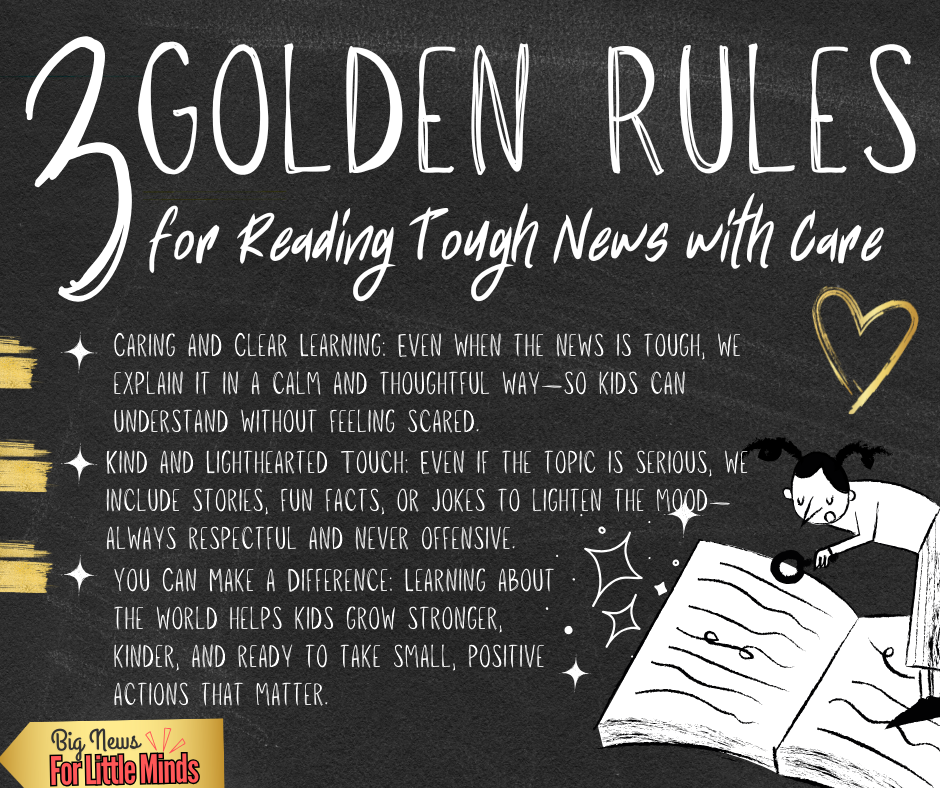
Important Reminder for Young Readers + Safety Tips – provides general guidance for approaching difficult news calmly, including asking questions, talking to trusted adults, distinguishing local from global events and focusing on positive problem-solving (page 9).
Kids’ Quiz Answer Key – provides the complete answers to all six multiple-choice questions in two Quick Check panels for straightforward marking (page 10).
This complete lesson plan combines a two-page current-events article with Fast Facts, six critical-thinking prompts, a Disaster Science Reporter writing task, DIY mountain-safety planning, a chain-of-events diagram/sketch task, Himalayan glacier history, a rescue-worker profile, disaster vocabulary, a six-question quiz and complete answer key. It approaches a serious disaster through science, geography, safety and thoughtful discussion while keeping the material suitable for young readers.
(As a Muslim, I firmly believe whatever God wills occurs and He is the Most Powerful, the All Wise!)
Behind the Pages ~ Big News for Little Minds’ Remarks
Welcome!
Our mission is to inspire young learners with captivating stories and fascinating facts. Designed for curious kids aged 7 and up, our resource-packed publications bring current events and historical moments to life in a fun, interactive way.
Special Inclusion:
In many of our publications, we aim to pack each package to the brim with learning fun! That’s why we’ve added bonus surprises such as “Be the Reporter” Newspaper Companion and “My First Newspaper” – A DIY Press Pack for Young Journalists. More recently, we’ve introduced “News Assignment: Twist the Tale” as an alternative freebie.
What We Offer… Behind the Pages: Every publication carries a unique message.
Learn more about the author’s teaching approach → Here
For Permissions or Inquiries: Contact us before purchase. Unauthorized use or reproduction is prohibited.
Resource Information:
PAGES: 22 (main part of resource covers: x 8 - 16 pages) Extra Pages, Real Talk: Part of the total page count—these 4-6 clean extras offer a quick look at our origins, rights and terms of use, how to reach us and stay connected, plus an optional tip jar. Cover pages are NOT within this file! Cover and preview images may vary slightly, and printed colors may appear differently due to printer settings and screen variations.
Ideal for Ages: Students in elementary school (only if they are ready for this type of publication). 7-9+
Teaching Duration: 1-2 class periods, depending on the depth of exploration.
Download Now: This digital resource is available immediately. Please remember to save your files upon download, as download limits may apply depending on the platform.
Reminder: This resource is for single-classroom use only. Please refrain from sharing it outside your class. Feel free to reach out with any questions before downloading. No refunds are available on digital products.
Note: We are not affiliated with any organizations or references mentioned in this document. This material is intended for educational purposes, presented in a kid-friendly tone—not to upset or offend anyone.
Note: While we strive for accuracy in every file, occasional errors can happen. If you notice anything that needs fixing, we kindly ask that you contact us directly instead of leaving a negative review. We’ll be happy to correct it promptly. Thank you for your understanding and support!
Disclaimer: This material is intended solely for educational purposes. The content provided does not promote any beliefs or practices that are inconsistent with Islamic values. All information is shared with the aim of fostering learning and understanding, and I do not endorse or promote anything that contradicts my personal beliefs.
This Resource has been Masterfully Crafted: My Vision, AI’s Precision…Hand-in-Hand We hope to Provide Top-Quality Products.
Your Feedback Matters! If you enjoyed this resource, we would be thrilled if you left a positive review! Your support helps us continue to create educational content that makes learning fun and meaningful for students. Thank you!
Thanks for being part of the learning adventure! Big News For Little Minds ~ Your Shortcut to Our Smart Collections!
Share